Resources / Founder profiles
What kind of founder am I? And how should that change how I lead?
You are probably not one kind of founder. You are a blend, and that blend should change how you set up your week, your team and your hardest decisions.
The short answer
The Founder Activation System describes four ways founder genius shows up under pressure: Breaker, Diamond, Snowballer and Herder. Each has pressure points that unlock your best work, and blockage points that, left alone, bring out a shadow. Most founders are a blend of two. Knowing your blend tells you three practical things: which conditions to build into your week, which shadow to catch early, and who you need beside you.
If you would rather find out first and read later, the free questionnaire takes about three minutes.
Why “what kind” is the wrong first question
Founders often ask this the way they would ask a personality test: just give me the label. The more useful question is a little different. It is not “who am I forever?” It is “what conditions unlock my best work, and what shadow appears when those conditions go missing?”
That shift matters because the same founder can look brilliant one quarter and stuck the next. Their talent did not change. The conditions did: a shock event, a tailwind, a headwind, a move to remote work, a team that suddenly fractures. These patterns often only become obvious when you watch someone move through changes like that. Once you can name your pattern, you can stop waiting for the right conditions and start designing them.
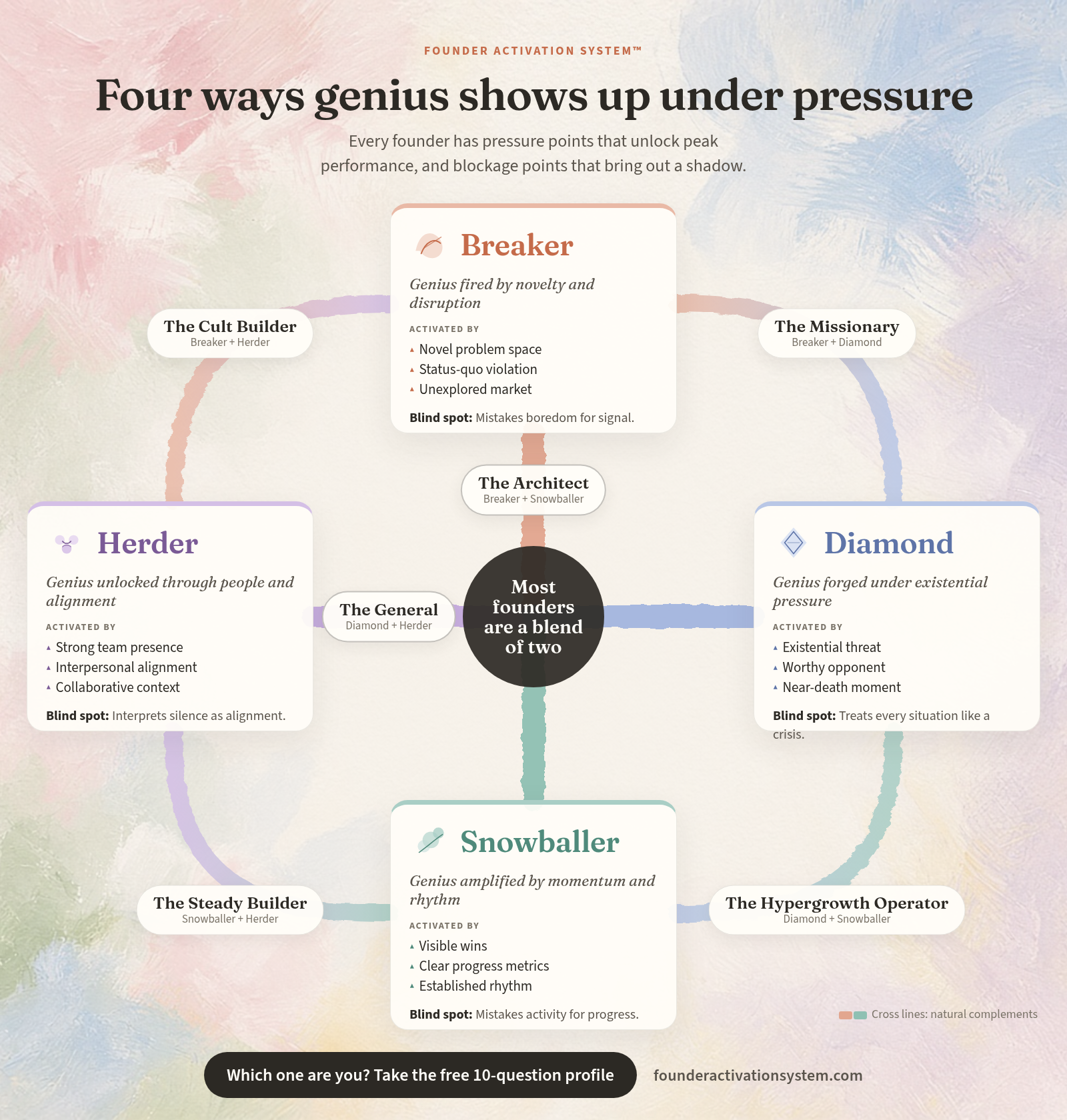
The four profiles at a glance
 Breaker: genius fired by novelty and disruption
Breakers come alive in a novel problem space, where the status quo is wrong and the market is unexplored. Their brilliance lives at zero-to-one. The catch is that the closer they get to completion, the less engaged they become. Repetition, routine and the execution grind switch them off.
Shadow: quietly sabotaging their own momentum to manufacture novelty. Blind spot: mistaking boredom for signal, and pivoting when they should execute.
 Diamond: genius forged under existential pressure
Diamonds show their brilliance under extreme pressure, existential threats and negative shock events. A worthy opponent or a near-death moment brings out their best. Comfort, safety and the absence of stakes do the opposite. It is the profile investors instinctively look for first.
Shadow: manufacturing internal conflict to create pressure when none exists. Blind spot: treating every situation like a crisis, and struggling to downshift when it is time to.
 Snowballer: genius amplified by momentum and rhythm
Snowballers are momentum players. They shine by taking decisive action, seeing tangible results and building on them. Visible wins, clear progress metrics and an established rhythm keep their flywheel turning. A stalled pipeline, a forced cold reset or a lost cadence stops it.
Shadow: doubling down on a dying motion rather than pivoting away from it. Blind spot: mistaking activity for progress.
 Herder: genius unlocked through people and alignment
Put a Herder alone and their genius goes offline. Put them with a team and they come alive, and instinctively know what each person needs. Strong team presence, interpersonal alignment and a collaborative context are their pressure points. Isolation, remote-only work and a fractured team are their blockage points.
Shadow: over-optimizing for harmony and delaying hard decisions to preserve comfort. Blind spot: interpreting silence as alignment.
Most founders are a blend of two
Pure types are rare. Your result will usually show a primary and a secondary profile, and each pairing has its own activation logic and its own risk:
- The Missionary (Breaker + Diamond): disrupts the market and will not stop until they win. Watch the execution gap.
- The Architect (Breaker + Snowballer): builds new systems and then scales them. The risk is building the wrong thing with great efficiency.
- The Cult Builder (Breaker + Herder): creates new ways of seeing and attracts believers. The risk is a culture built around disruption with no business model underneath.
- The Hypergrowth Operator (Diamond + Snowballer): intensely competitive and relentless on execution. The risk is burning through people.
- The General (Diamond + Herder): pushes hard to win and earns loyalty doing it. The risk is that under pressure the Diamond shadow takes over and the Herder instinct disappears.
- The Steady Builder (Snowballer + Herder): compounds results through consistent execution and team alignment. The risk is being caught out when the market shifts fast.
How your profile should change how you lead
1. Design your conditions on purpose
Your profile tells you what to build into your week instead of hoping it shows up. A Snowballer coming off a hard quarter should engineer the smallest possible win and build on it straight away. A Breaker running a company that now needs steady execution may need a regular ritual that pulls them back into the details. A Diamond in a calm stretch does well to look hard at the best in their category and how far they still have to go. A Herder stuck working remotely should get in the room, in person when possible, with the people they least want to let down.
2. Learn what your shadow looks like early
Shadows rarely announce themselves. They look like your strength turned up one notch too far. The Breaker who wants to redesign onboarding two weeks before launch. The Diamond who sets a target 40% above what the board asked for. The Snowballer who adds another touchpoint to an outreach sequence while reply rates keep falling. The Herder who schedules a team offsite instead of the hard conversation. Write down your blind spot, and give one person you trust permission to name it when they see it.
3. Build your team around your complement
Each profile has a natural complement. A Breaker needs a Snowballer to provide the sustained momentum they cannot hold, and a Snowballer needs a Breaker to inject disruption when momentum turns into inertia. A Diamond needs a Herder to soften the blast radius and protect the culture, and a Herder needs a Diamond to force the decisive action they naturally avoid. Breaker and Snowballer is the strongest pairing in the model: one creates, the other scales. Diamond and Herder is a yin-yang pairing: one drives, the other keeps the team.
4. Match your mode to your stage
What your company needs from you changes as it grows. At pre-seed, the whole value proposition is a novel insight, which is Breaker territory, and investors read Diamond intensity as conviction. At Series A, scaling a proven motion is the whole job, so it is peak Snowballer stage, while a Breaker’s instinct risks disrupting what just started working. By Series B and beyond, culture at scale becomes a moat, and unchecked Diamond intensity can damage it. Your profile does not change with the stage. What you lean into should. If the company started working and your drive did not come with it, read why founders lose drive after product-market fit.
5. Treat range as a skill
Knowing your default is not permission to stay in it. Behavioral flexibility is range, not inconsistency: the ability to consciously reach beyond your default when the situation needs something else. When you notice yourself resisting what the moment needs, ask yourself one question.
“Are you defending your mode as a principle or as a preference?”
Principles hold when they cost you something. Preferences tend to fall apart under honest scrutiny.
Find your profile in about three minutes
The free questionnaire has 10 questions. For each one, you rank four responses from most like you to least like you. Your result shows your weighted skew across all four profiles, including your secondary. Go with your first instinct; it is usually the most accurate. Your answers stay in your browser, with no account, no email and no tracking.
Once you have your result, the Blends, Pair matrix and Team builder tools on the same page show how it plays out with a co-founder and at your stage. It is worth sending to your co-founder too. Comparing two results is often where the useful conversation starts.
Frequently asked questions
What are the four founder profiles in the Founder Activation System?
Breaker (genius fired by novelty and disruption), Diamond (genius forged under existential pressure), Snowballer (genius amplified by momentum and rhythm) and Herder (genius unlocked through people and alignment). Each has pressure points that unlock peak performance and blockage points that, left unaddressed, produce shadow behaviors.
Can I be more than one kind of founder?
Yes. Most founders and executives are a blend of two profiles. Each of the six pairings has its own name, strengths and shadow risk, from The Missionary (Breaker + Diamond) to The Steady Builder (Snowballer + Herder).
Is the founder profile questionnaire free, and how long does it take?
It is free and takes about three minutes. There are 10 questions, and for each one you rank four responses from most like you to least like you. Your answers stay in your browser: no account, no email, no tracking.
Is my founder profile fixed?
Treat your profile as a map of operating conditions, not a personality label. The useful question is what conditions unlock your best work, and what shadow appears when those conditions go missing. With practice, founders build range beyond their default mode.
What is the strongest co-founder pairing?
Breaker and Snowballer is the best pairing in the model: the Breaker creates and the Snowballer scales. Diamond and Herder is a yin-yang pairing: the Diamond drives and the Herder retains, so together they build and keep great teams.
What if my scores are spread evenly across all four profiles?
An even spread can reflect genuine range, or it can signal an operator and integrator profile rather than a primary founder profile. People with this result often excel as COO, Chief of Staff or the glue of a founding team.
Next step
Recognize your pattern, or your co‑founder’s?
Start with the free profile. When you want a working partner for what it shows, the next step is a direct conversation with Jon.